An intelligence analysis platform built for serious investigative work — and deployed entirely on infrastructure you own and control.
The AI runs on your hardware. Every query, document, and analyst interaction stays within your security perimeter. Not by policy — by architecture.
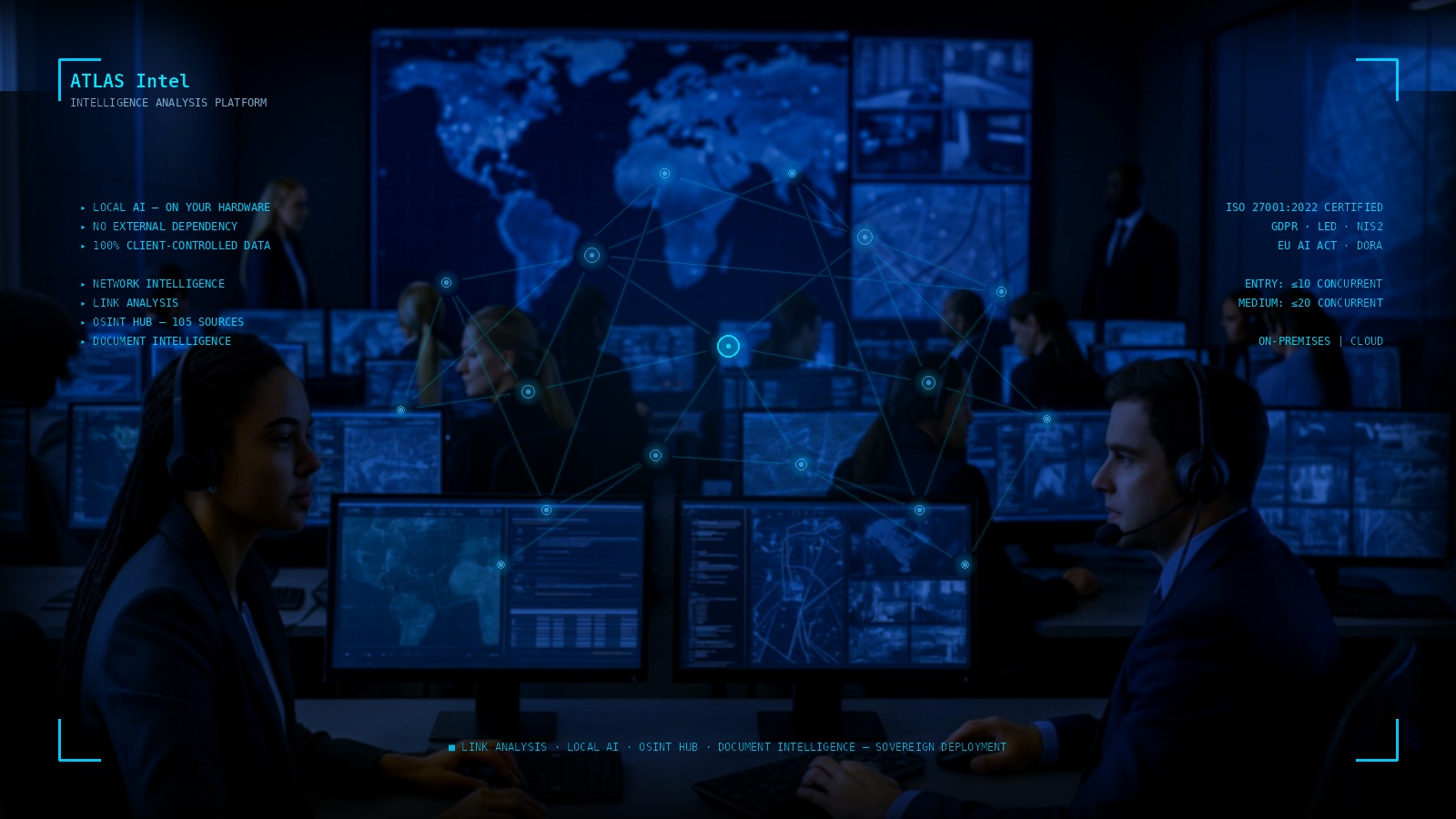
Intelligence analysts work to understand complex criminal networks, financial fraud operations, terrorist financing chains, and cross-border criminal activity. They manage thousands of entities, millions of connections, and large volumes of documents — across investigations that must ultimately stand up in court.
ATLAS Intel is built for that work. It runs entirely on infrastructure owned and controlled by the client — physical servers on-premises or the client's own cloud environment. Every component, including the AI model, operates inside the client's security perimeter.
No data, query, document, or analyst interaction ever reaches an external system. No telemetry. No outbound transmission of any kind.
On the client's own infrastructure — on-premises servers or the client's own cloud. 3EECO configures, never hosts.
100% client-controlled. No telemetry. No outbound transmission of any kind.
Local LLM on client infrastructure. No external AI provider. No data leaves the client's perimeter.
ISO 27001:2022 certified. Five independent verification layers per request. Full immutable audit trail.
Every analyst action — queries, data reads, document uploads — is recorded in an immutable, tamper-resistant log. Every output references its source data.
Multilingual — OCR, AI extraction, and interface available in English, Italian, French, and Romanian.
Link analysis, local AI, OSINT hub, and document intelligence are included at every tier. No modules purchased separately. No capability withheld behind a higher price.
Every capability is included at every tier. Nothing is held behind a higher price point.
Analysts build and navigate visual maps of every person, organisation, transaction, location, and event connected to an investigation. Every relationship is typed, sourced, and timestamped. The result is a live, queryable intelligence graph that surfaces connections across cases, data sources, and time.
A large language model runs entirely on the client's infrastructure. Analysts query the platform in plain language and receive structured answers drawn from the investigation data. No external AI provider. No cloud service is involved. The model operates entirely within the client's perimeter — permanently, not conditionally.
Live feeds from open-source intelligence sources — corporate registries, sanctions lists, PEP databases, adverse media, social signals, and domain intelligence — connect directly to the analysis environment. Data is ingested, structured, and linked to cases automatically. All collection stays within the client's infrastructure.
Documents the investigation generates or receives — PDFs, scanned records, bank statements, court filings, photographs of documents, foreign-language materials — are automatically processed. The AI extracts entities, relationships, dates, and amounts. Analysts query the document corpus in plain language. Every output references its source document.
An optional add-on extending ATLAS Intel with forensic analysis of investigative media archives. Facial search across photo and video archives. Voice recognition and speaker identification across audio corpora. Object detection across large media collections. Runs entirely on client infrastructure — the same sovereign architecture as the base platform. Post-hoc analysis of legally acquired material only. No live surveillance. No autonomous decision-making. Human oversight mandatory by architecture. Requires base ATLAS Intel. Quoted separately.
Analysts query the platform in plain language. The platform returns structured, source-referenced answers drawn from the full intelligence picture.
"Show me every individual connected to Organisation X within two degrees, including any link to a sanctioned entity or adverse media entry."
"Extract all named individuals and vehicle registrations from the documents uploaded this week and map them to existing case entities."
"Identify all counterparties appearing in transactions above €50,000 that are also registered in a high-risk jurisdiction or connected to a PEP."
"Summarise all recorded financial flows between Subject A and any offshore-registered entity in the past five years, with source references for each item."
"Screen all entities registered in the past 90 days against current OFAC, EU, and UN sanctions lists and flag any match for review."
"Generate a structured intelligence summary on Subject B, with a source reference for every stated fact."
The EU Law Enforcement Directive — Directive (EU) 2016/680 — governs how police and competent authorities process personal data for criminal justice purposes. ATLAS Intel is architected to support the requirements of the LED: processing is purpose-limited by design, data access is role-restricted at the case level, and a complete tamper-resistant audit trail records every interaction. A LED-specific Data Processing Addendum is available for law enforcement client engagements.
When the SPECTRUM add-on is deployed, investigators can also submit forensic media queries — searching investigative archives by face, by voice, and by object. All results are returned inside the same ATLAS Intel workspace.
"Search the entire CCTV archive for any individual matching this reference photograph."
"Find all frames containing this suspect across all video files seized from the premises."
"Compare this photograph against all identity documents processed in the past 90 days."
"Find all segments in the intercept archive where this voice appears — with timestamp and source file reference."
"Confirm whether the speaker in this recording is the same individual as in these prior intercepts."
"Identify all distinct speakers in this audio corpus."
"Locate all frames showing a white van matching this description across all video files in this investigation."
"Find all images in the archive containing a firearm — return source file and timestamp."
"Search all seized device photos for identity documents or currency."
An optional add-on module. Not a separate product. Every SPECTRUM result appears directly inside the ATLAS Intel investigative dashboard — linked to cases, entities, OSINT data, documents, and financial intelligence already in the platform.
Compares a reference image against an indexed archive of investigative photographs, video frames, document scans, and device extractions. Returns a ranked list with confidence level, source file reference, timestamp, and metadata. Includes direct two-image comparison mode. Biometric indices stored exclusively on client infrastructure.
Analyses audio from authorised intercepts, voicemails, ambient recordings, video audio tracks, and seized device audio. Builds a searchable index of voice profiles. Returns matching segments with timestamps, source references, and confidence levels. Speaker identification across the full investigative corpus. Full local processing.
Searches large photo and video archives for specific objects via reference image, library selection, or custom classification. Standard categories: vehicles, licence plates, weapons, electronic devices, documents, identity documents, currency, drug packaging. Custom categories trained at onboarding — no coding required.
SPECTRUM results appear inside the ATLAS Intel investigative dashboard alongside case entities, OSINT results, document intelligence, and financial data. No separate interface. No data export required.
Any SPECTRUM result inserts into the active case as a structured entity. Source reference, timestamp, confidence score, and analyst ID are attached automatically. Immediately available to the investigative LLM alongside all other case data.
Every SPECTRUM operation is recorded in ATLAS Intel's audit log — source material, timestamp, confidence score, analyst ID, and validation action. Complete chain from raw media file to evidence record. Tamper-resistant. Built to hold under legal scrutiny.
The investigative LLM queries SPECTRUM results alongside all other case data — correlating identified faces, voices, and objects with OSINT entities, financial records, and documents in plain language. Structured, source-referenced answers.
SPECTRUM requires base ATLAS Intel. On-premises: requires a second dedicated GPU (separate from the LLM GPU) and a dedicated media storage volume — both procured by the client. Client cloud: client provisions a dedicated GPU instance and storage volume within their own cloud environment. Full air-gap capable. No external connectivity required.
3EECO configures and supports the platform in both cases. 3EECO does not host client data and is not a cloud provider.
Installed and runs on physical servers at the client's site. The client's IT team manages the hardware. 3EECO installs, configures, and supports ATLAS Intel on that infrastructure.
Deployed inside the client's own cloud account — AWS, Azure, Google Cloud, or a private cloud. The client manages the cloud infrastructure. 3EECO configures ATLAS Intel within that environment.
The only difference between the two paths is in onboarding — cloud deployments replace physical hardware installation with cloud environment provisioning. Scope and cost are equivalent. Same platform, same pricing, both paths.
The platform's sovereign architecture — all processing within the client's own infrastructure — provides the technical foundation that underpins every position below.
Formally certified information security management system — covering data confidentiality, integrity and availability, access control, incident management, and business continuity. Certification is maintained through ongoing independent audit.
Privacy by design and by default. On-premises and client-cloud deployment keeps all personal data within the client's infrastructure. The platform supports both GDPR obligations and the EU Law Enforcement Directive (2016/680) — with a LED-specific Data Processing Addendum available for law enforcement engagements.
ISO 27001:2022 Annex A controls address the same security domains as NIS2 Article 21. The sovereign on-premises deployment model supports minimal risk classification under the EU AI Act. Full ICT risk management documentation, business continuity records, and concentration risk statements are available for financial institution procurement teams subject to DORA.
The platform's audit trail, document intelligence pipeline, and case management architecture are built to support client obligations under FATF Recommendations 10, 11, and 20. Entity screening against sanctions lists and PEP databases directly supports client compliance with AMLD6 requirements.
SPECTRUM is designed exclusively for post-hoc forensic analysis of legally acquired material. No real-time biometric identification. No live monitoring of public spaces. No autonomous decision-making. Architecture supports high-risk law enforcement AI system classification within the permitted framework. Mandatory human oversight enforced at architectural level — no SPECTRUM result enters the evidence record without analyst validation. Full technical documentation maintained.
Biometric and voice data processed exclusively for authorised investigative purposes under competent authority mandate. Role-based access control, case-level data segregation, purpose-limited processing by design, immutable audit trail, and complete logging of all operations on biometric and voice data. LED-specific Data Processing Addendum available covering biometric and voice data processing.